

relationship communication issues are one of the most common reasons couples feel disconnected. But here is the good news: healthy communication is not a magical gift some people have and others don’t. It is a skill. This therapy guide will explain why you get stuck and share the core skills taught in couples therapy for communication to help you improve communication in your marriage.
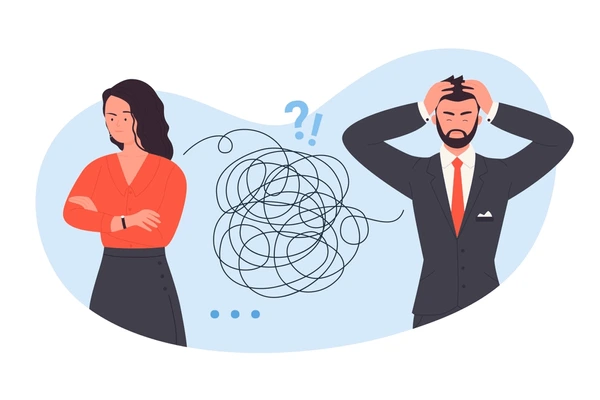
Why You Talk Past Each Other: The 4 Hidden Barriers
Before learning new techniques, it’s crucial to understand why your current communication fails. Usually, one of these four barriers is at play.
Barrier 1: You’re Listening to Respond, Not to Understand
This is defensive listening. Instead of truly hearing your partner’s words and the emotions behind them, you are busy formulating arguments and preparing your rebuttal. Connection is impossible when the goal is to win, not to understand.
Barrier 2: Unresolved Past Issues Are Poisoning the Present
Often, the fight about the dishes isn’t really about the dishes. It’s about all the other times one partner felt unsupported. This emotional baggage and collection of old resentments can hijack a present-day conversation, turning a small issue into a major conflict.
Barrier 3: You’re Speaking Different Emotional Languages
You may have fundamentally different expectations or ways of showing love and concern. One partner might need verbal reassurance, while the other shows love through actions. When these unmet needs aren’t understood, both partners can end up feeling unloved and unappreciated.
Barrier 4: You’re Stuck in a Negative Cycle (Criticism/Defense)
Many couples fall into toxic patterns. One partner might lead with criticism (“You always…”), which triggers an immediate defensive reaction in the other (“No, I don’t! You’re the one who…”). This blame game is a destructive loop that goes nowhere.
The Core Skills Taught in Couples Therapy for Communication
A therapist acts as a coach, teaching you a new playbook for communication. Here are four of the most effective skills.
Skill #1: The Speaker-Listener Technique (Active Listening on Steroids)
This is a structured exercise where one partner is the designated “Speaker” and the other is the “Listener.”
-
The Speaker talks about their feelings using “I” statements.
-
The Listener’s only job is to listen and then paraphrase what they heard (“What I’m hearing you say is…”). They cannot rebut, defend, or problem-solve.
-
This process ensures both partners feel fully heard and understood, often for the time. It is about validating feelings, not agreeing with facts.
Skill #2: Using “I Feel” Statements (Taking Ownership of Your Emotions)
This simple shift in language is revolutionary. Instead of a blaming “You make me so angry,” you use non-blaming language: “I feel angry when the bills are paid late because it makes me feel insecure.” This focuses on expressing feelings and taking responsibility for them, which is far less likely to trigger defensiveness.
Skill #3: The Gentle Start-Up (How to Raise an Issue Without a Fight)
How you begin a difficult conversation often determines how it will end. A harsh startup (“Why didn’t you take out the trash again?”) invites conflict. A soft approach works wonders: “Hey, I’m feeling a little overwhelmed by the chores. Can we find 15 minutes to talk about a plan?” This method avoids criticism and invites collaboration.
Skill #4: The Art of the “Time-Out” (Pausing Before You Damage)
When a conversation gets too heated, your brain’s fight-or-flight response takes over, making productive conversation impossible. A “time-out” is a pre-agreed signal to pause the conversation. It’s not about running away; it’s a strategic tool for de-escalation. The key is to agree on a specific time to return to the conversation (e.g., in 30 minutes) after you’ve both had a chance to calm down.
 A Practical Exercise You Can Try Tonight: The Daily Check-In
Here is a simple but profoundly effective communication exercise for couples. Set aside 10-15 minutes of distraction-free time. Each partner gets to answer two questions, while the other just listens:
-
“What was stressful for me today?” (This builds empathy.)
-
“How did I feel loved or appreciated by you today?” (This builds positive connection.) This simple ritual can rebuild emotional intimacy one day at a time.
Why a Neutral Third Party Makes All the Difference
Knowing these skills is one thing; putting them into practice during a heated moment is another. A therapist acts as a coach for your communication “muscle memory.” They can:
-
Slow down the conversation in real-time.
-
Point out destructive patterns as they happen.
-
Provide a safe space to practice these new, awkward skills until they become natural.
Stop Having the Same Fight. Start a New Conversation.
Effective communication is a skill, not a gift. It can be learned, practiced, and mastered. You don’t have to be stuck in the same painful cycle forever. You have the power to learn a new way to connect.
If you are tired of the endless arguments and painful silences, our specialists can provide the coaching you need. Explore our blog for more insights on and learn how we can guide your new conversation.

Your Top Questions About Communication Issues
Can our communication really be fixed if it’s been bad for years? Yes. While it takes time and effort to unlearn old habits, it is absolutely possible. The key is the willingness of both partners to learn and practice new skills. Consistency is more important than perfection.
What if I feel like my partner is the one who won’t listen? This is a very common feeling. In therapy, you will learn skills to express yourself in a way that makes it easier for your partner to hear you. Often, when one person changes their approach, the entire dynamic shifts.
How quickly can we expect to see improvements in our communication? With consistent practice, many couples notice small but significant improvements within the first few sessions. The feeling of being truly heard, even once, can create a powerful sense of hope that motivates further change.
Are there any books you recommend for improving communication? Absolutely. A foundational text we often recommend is “Nonviolent Communication” by Marshall Rosenberg. It provides a wonderful framework that complements the work done in therapy. For more personalized recommendations, please








 English
  Chinese